Shoulder Pain in Bentonville and Springdale, AR
You have iced it, stretched it, and started sleeping on the other side. If reaching overhead still costs you something, one evaluation is where the guessing stops.
What causes shoulder pain?
The shoulder trades stability for range. It is the most mobile joint you own, and it stays in place only because a small group of muscles keeps it centered through every reach. When those muscles fatigue, when the shoulder blade stops gliding, or when the joint takes on more load than it has been trained for, the tissue that absorbs the difference is the tissue that starts to hurt. Naming the real driver is what separates relief that holds from a good week followed by the same ache.
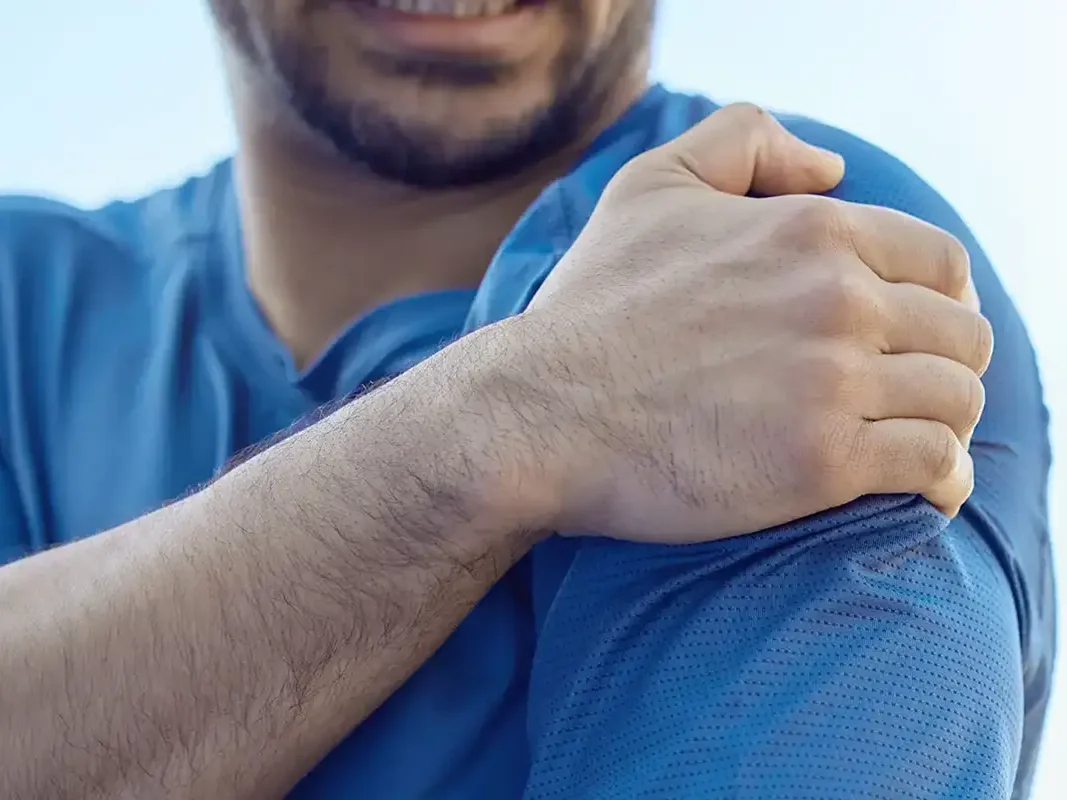
Four small muscles wrap the ball of your shoulder and hold it centered in the socket. Overuse frays them slowly, a fall or a hard catch can tear them quickly. The tell is pain when you reach overhead or lie on that side at night. Many partial tears do very well without surgery, because a cuff that is stronger and better coordinated takes pressure off the damaged fibers. Your therapist will tell you honestly which category yours looks like.
When the cuff fatigues, the head of the arm bone drifts upward a few millimeters and pinches the tendon and bursa that sit above it. That is the sharp catch you feel partway through a reach. The space itself is rarely the problem. Restoring the muscles that keep the ball centered, and freeing the shoulder blade so it rotates out of the way, usually opens the movement back up.
The capsule around the joint thickens and tightens, often after an injury, a surgery, or a stretch of not using the arm. Range disappears in every direction, including when someone else moves the arm for you, and the ache is deep rather than sharp. Frozen shoulder runs a long course, but graded joint mobilization and consistent stretching shorten it and keep you from losing strength while you wait.
The long head of the biceps runs through a groove at the front of the shoulder and blends into the rim of cartilage that deepens the socket. Repeated overhead work, pressing, or throwing irritates it, and you feel it as a pinpoint ache at the front of the joint. Calming the tendon and rebuilding control through the whole arm usually settles it without imaging or injection.
A large share of your overhead reach comes from the shoulder blade rotating across the ribs, not from the ball and socket at all. When the muscles that steer the blade are weak, or the upper back beneath it is stiff, the joint has to make up the difference on every rep. That borrowed motion is what grinds tissue down over months. Freeing the upper back and training the blade is often the piece nobody addressed.
The small joint on top of the shoulder, where the collarbone meets the shoulder blade, takes a beating from falls, bench pressing, and years of overhead work. Pain sits right on top and flares when you reach across your body. Load management plus better mechanics through the rest of the shoulder usually quiets it down.
How physical therapy in Bentonville and Springdale helps.
You do not need a physician referral to start. Arkansas is a direct access state, so you can book an evaluation now, and we verify your benefits before your first visit. Your therapist begins by measuring what the shoulder will actually do: how far it moves on its own, how far it moves with help, where the strength drops off, and how the shoulder blade behaves while you reach. That tells us which of the causes above is yours. Early visits use hands-on joint work and soft tissue release to give the movement back and settle the guarding. After that the work turns to loading: cuff strength through the range you had been avoiding, shoulder blade control, and upper back mobility. You see the same therapist every visit, and the plan changes as you do. The goal is not a quieter shoulder. It is a shoulder that handles the top shelf, the tool bag, and a full night on that side.
What to expect from your recovery.
Your evaluation
The first visit is hands on from the start. We measure range in every direction, test cuff strength position by position, watch how the shoulder blade tracks while you lift, and screen the neck and upper back that feed into it. We also look for anything that belongs in a physician's hands. You leave knowing what is driving the pain and an honest estimate of how long this should take.
Getting motion back
Next we open the shoulder up. Joint mobilization, soft tissue release, and targeted dry needling (at our Bentonville clinic) calm the overworked tissue and give you back the range you have been working around. Every technique has a reason, and your therapist explains it before it happens rather than after.
Strength that holds
Then we load it. Rotator cuff and shoulder blade strengthening, progressed a step at a time, teaches the joint to stay centered under real weight. We build the program around what you actually do, whether that is lifting a grandchild, swinging a golf club, or working overhead all day, so the gains outlast your last visit.
I received treatment at Russ Physical Therapy after my rotator cuff surgery, and the experience was outstanding. The staff was incredibly caring, thorough, and compassionate.
Pain rarely travels alone.
Elbow, Wrist & Hand Pain
A guarded shoulder changes how the whole arm works, and the elbow and wrist absorb the difference. Treating the chain is what stops the pain from simply moving down it.
Joint Pain
If the shoulder is one of several joints that ache and stiffen, the driver may be systemic rather than local. That changes how we build your plan.
Neck Pain
Nerves that supply the shoulder start in the neck, so neck irritation can be felt as shoulder pain. We screen both before deciding what to treat.
Ready when you are.
Fri: 8:00am - 1:30pm